Questions about h2o/meth inj kits

Collapse
This topic is closed.
X
X
 
  • Time
  • Show
Clear All
new posts

  • TGP37
    replied
    Originally posted by caffeine View Post
    The local speed shop recommended to me not to go past a 50/50 meth/water mix. In fact they actually recommended using off-the-shelf windshield washer fluid (many are between 40 and 50% meth).

    Not saying 80% will do this but apparently not too long ago they built an engine for someone and that person decided to use 100% meth instead of 50% (what was recommended) and they ended up melting their pistons and trying to sue.

    Edit: the way I understand it is that water is what reduces the temps and meth boosts octane BUT too much meth in the mix will burn much hotter than just gasoline.
    I see, I do monitor my egt's.

    I very much want detonation suppression which requires at least 15/85 water/meth ratio from what i am reading. I wouldn't run 100% meth w/o safety controls in place.

    I do believe in mixing water w/ the meth.

    Considering my lack of hands on experience with meth injection, I pretty much decided to start out smart and use 50/50 plus the recommended nozzle size.


    My only question now is if I want to port inject 6 nozzles at 0.75 gal/hr or 1 nozzle at 4 gal/hr. I heard port injection provides better detonation suppression, but I would like your guys opinion.


    EDIT: Gonna answer one of my questions. Port injection allows more water to reach the cylinder unevaporated, allowing for more detonation protection versus the cooling effect still present, just not as much. Also ensures the proper amount of water/meth is reaching each cylinder allowing more balanced performance, easier to tune.
    Last edited by TGP37; 02-09-2013, 02:35 PM.

    Leave a comment:


  • caffeine
    replied
    The local speed shop recommended to me not to go past a 50/50 meth/water mix. In fact they actually recommended using off-the-shelf windshield washer fluid (many are between 40 and 50% meth).

    Not saying 80% will do this but apparently not too long ago they built an engine for someone and that person decided to use 100% meth instead of 50% (what was recommended) and they ended up melting their pistons and trying to sue.

    Edit: the way I understand it is that water is what reduces the temps and meth boosts octane BUT too much meth in the mix will burn much hotter than just gasoline.

    Leave a comment:


  • TGP37
    replied
    I did some reading, seems injecting 80% methanol with 20% water is an interesting ratio.

    Allowing 50% gas and 50% mix injected. Which is 50% Fuel / 40% Methanol / 10% Water

    The water released from the methanol during combustion brings the water content closer to the optimal 15%.


    Thinking further, injecting this mix can really help the injector duty cycle at higher rpms. Basically allowing smaller injectors to be used (if the ones needed are too large to idle well this is a good thing)!


    What I don't get yet is how to control the AFR if the meth injection fails. Obviously cutting that much fuel is a lot to not have the methanol part to compensate. Maybe I can ground the O2 signal to command open loop with OL tables adjusted for no methanol. Or simply kill the ignition and shut the engine down if meth injection fails (not too different from a fuel injector failing anyways). Just would need a sturdy system that won't easily fail with a sufficient amount of mix, like 10 gallons for long drives.

    Leave a comment:


  • TGP37
    replied
    AleroB888, that looks really nice!

    Leave a comment:


  • AleroB888
    replied
    recent

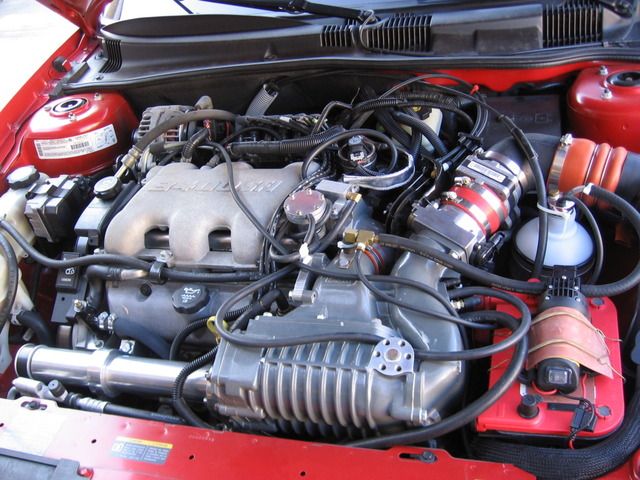
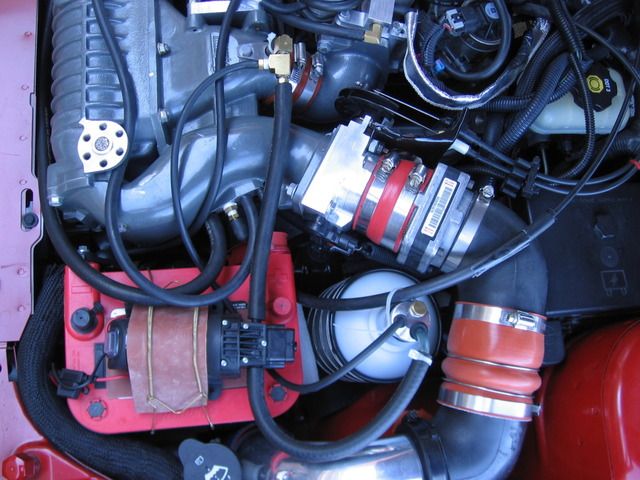
    The IAT sensor is in the back port of the UIM, where the PB hose used to be.
    Wiring for pressure switch is hidden in front of battery, bottle is reinforced.

    Last edited by AleroB888; 02-08-2013, 01:26 PM.

    Leave a comment:


  • TGP37
    replied
    Cool, thanks Alero.

    Caffeine, your right. The plenum injection is for detonation suppression while the injection into the compressor will cool the charge ahead of the IAT sensor. The intake will be slightly cooler injecting past the IAT but it shouldn't be a problem.

    If the intake were to heat up past the IAT, then I would be concerned.


    I did some math and I came up with some interesting results. The nozzle selector says a 4~5 gal/hr nozzle will work best but that isn't the case.

    The system starts flow at 15% of nozzle max flow.

    A D04 nozzle would have to turn on well below boost to be 15% of the fuel injected (at 11.8 AFR).
    A D07 nozzle at 15% will be proper around 4-5 psi and max flow is well out of my boost range. But the linear increase in meth/h20 injection will match the fuel flow increase. In this case, I will never reach max flow (set up near 30 psi and I run 12 psi) but the ratio will be spot on.

    Leave a comment:


  • caffeine
    replied
    Isn't it best to place the nozzle before the IAT since the meth injection will affect intake temps?

    Leave a comment:


  • AleroB888
    replied
    Originally posted by TGP37 View Post
    ....
    I'm thinking about tapping the plenum about 1 inch past the goofy PCV port and spray in the neck of the plenum from directly above.
    That may be a good spot. On this one I still have the EGR (for now) but the SC kit uses that space.

    Leave a comment:


  • TGP37
    replied
    I got an interesting question for you guys......

    Not considering cost, what is ideal for best atomization?

    1- port* injection with 6x 63ml nozzles
    2- throttle injection w/ 1x 380ml nozzle

    * injected in the plenum runner or LIM runner?

    I think I can get some low profiles in there near the injectors. Though tapping the runners on the plenum is way easier and might look badass.

    Leave a comment:


  • TGP37
    replied
    I'm liking the Devilsown kits. They seem to have great reviews by many who use it. And they seem to have the highest psi pump out there at 250psi.

    I have read it is possible to spray into the compressor while having the MAF downstream and not mess up it's flow readings. Often stated it needs to be done properly but hardly mentions what exactly improper is.

    I think it is nothing more then atomization, having no leaks/drips and the proper flow amount. The obvious stuff.


    I do believe spraying into the compressor at 10% and into the plenum at 15% (% of fuel weight delivered) would do well for what I want.

    I think aiming the nozzle directly at the compressor blade center (the nut) would be best to deliver the water/meth mist evenly into the blades to prevent damage. Just don;t want that nozzle flying into the compressor, lol, that would suck.

    Leave a comment:


  • unchained01
    replied


    AND
    http://www.alcohol-injection.com/en/nozzle-selector.php
    Last edited by unchained01; 02-03-2013, 07:51 PM.

    Leave a comment:


  • AleroB888
    replied
    Originally posted by TGP37 View Post
    Open Loop is right up my alley.....tuning is no problem. Have an HPT and can use a DHP when needed for Tinytuner tables.

    How about this tip?

    What concerns me about a custom build is the ability to progressively control the flow. Which makes a kit really tempting.

    I'm thinking about tapping the plenum about 1 inch past the goofy PCV port and spray in the neck of the plenum from directly above.
    The style of nozzle ranges from a simple pinhole, which requires way more pressure for atomization, to styles with internal channels and plates. I disassembled a few old-time spray bottles and found many ingenious variations. The more complex, the more difficult to machine.

    I would start with a manual switch and watch what happens in the scans for different spray rpm and duration.

    Flowrate and spray patterns are easy enough to test.
    Last edited by AleroB888; 02-03-2013, 06:57 PM.

    Leave a comment:


  • TGP37
    replied
    Open Loop is right up my alley.....tuning is no problem. Have an HPT and can use a DHP when needed for Tinytuner tables.

    How about this tip?

    What concerns me about a custom build is the ability to progressively control the flow. Which makes a kit really tempting.

    I'm thinking about tapping the plenum about 1 inch past the goofy PCV port and spray in the neck of the plenum from directly above.
    Last edited by TGP37; 02-03-2013, 06:34 PM.

    Leave a comment:


  • AleroB888
    replied
    The key ingredient for these devices is the nozzle tip, just as with fuel injectors. The degree of atomization is all-important, imo. After that, it's the quality of the pump, and location of the nozzle. I believe someone suggested that open-loop tuning was needed for the PCM to avoid the problem of its compensating for the extra fuel, I don't have any experience with that. If you can find a high-quality replacement nozzle somewhere, you could probably make your own kit.

    Leave a comment:


  • TGP37
    replied
    Just thought of this......these manifolds have two ports so a boost referrenced FPR could be used to adjusts the water pressure. Creating a feedback loop to control pressure like the fuel system. Then both systems would adjust pressure in-sync according to manifold pressure changes. Kind of like balancing the ratio injected mechanically versus electronically. And be able to inject per runner.
    Click image for larger version

Name:	1280__39833.1355615548.1280.1280.jpg
Views:	1
Size:	181.4 KB
ID:	377380Click image for larger version

Name:	1280__93187.1355685292.1280.1280.jpg
Views:	1
Size:	106.3 KB
ID:	377381

    Even though the fuel is PWM and the spray is constant, the change in manifold pressure is the same on both systems which only distorts the measured amount.

    But this means the reservoir needs a return line. At this point a fuel cell might be an interesting reservoir idea....no aluminum of course.
    Last edited by TGP37; 02-03-2013, 12:36 PM.

    Leave a comment:

Working...