
Think I should clean the oil pump screen?

Collapse
X
 
  • Time
  • Show
Clear All
new posts

  • 85_Olds_Ciera
    replied
    Originally posted by betterthanyou View Post
    Man that article is way off on oil pressure.
    1988 Chevrolet Owners Manual: Beretta

    Readings of 205 to 275 kPa (30 to 40 psi) may be considered normal during moderate road speeds of 55 to 60 km/h (35 to 40 mph) with the engine at proper operating temperature. If equipped with the optional LB6 engine (engine Code W), the oil pressure reading could be extend an additional 10 psi (70 kPa) higher under the same operating conditions described above.

    But again, the OEM pump had its spring set at 70 psi (Code W: LB6)...but this Milling Oil Pump blows at 60 psi. Hence, unless an OEM pump was installed...who knows to be exact on readings.
    Leave a comment:


  • 85_Olds_Ciera
    replied
    Originally posted by betterthanyou View Post
    Man that article is way off on oil pressure.
    RE:
    .
    Engine Oil Pressure
    .
    Oil Pressure should be 25-40psi at 1000rpm and 45-55psi at 2000rpm. Minimum oil pressure should be 15psi at 1000rpm and 30psi at 2000rpm. If this is not the case clearances betwen the bearings and crankshaft journals are excessive. Pressure should be checked only when the engine is warmed-up.
    At 1,000 RPM Hot...the 25 psi may be a valid number...I have not checked this RPM...but off idle, my oil pressure does pick up quickly.

    >45-55psi at 2000rpm

    This is within the range I am seeing (*45*) at 2100 RPM HOT...but I feel this new Milling pump's bypass circuit is kicking in...since even if you take it up to 4,000+ RPM...it's still *45* psi.

    >Engines don't need enormous amounts of pressure.

    True...when enough bearing surface area exists...

    My 855 Cumins (N14) maxes out at 45 psi Hot at 2100 RPM; that's the way they designed it to save fuel in 1994...at idle, they allow 10 psi on the low side....at 1,000 RPM, its up to 30 psi.

    Gas engines, if enough bearing surface area exists, don't need much for lower horsepower applications. My in-law's 1 ton 4x4 has around 45 psi hot at idle...if I recall the conversation correctly

    Leave a comment:


  • 85_Olds_Ciera
    replied
    Originally posted by betterthanyou View Post
    At cold idle you may reach the pressure relief. But hot idle will not. If you are getting 30 PSI at idle thats a lot but still not near the 60 or 70 PSI the relief opens at.
    I have run some tests on this new stock Melling Pump installed. On my digital dash, oil pressure is given in number of bars seen...I determined via shop-air hook direct to oil-sender that

    5 Bars = 30 psi...and
    9 Bars = 60 psi

    Hot Idle:

    a. 10-40 - 3 Bars
    b. 5w-30 - 2 Bars

    Cold Idle

    a. 10-40 - 9 Bars
    b. 5w-30 - 8 Bars (but just after oil change with warm engine)

    After 2100 RPM, 5w-30 (Quaker) stays pegged at 7 bars (42 + psi)
    10-40 has similar results...

    Conclusions -

    A. With Cold Idle, bypass is kicking in

    B. With Hot Idle, bypass is not kicking in

    C. After 2100 RPM (Hot), by-pass is kicking in.

    D. By-pass spring tension is temperature dependent; as temp increases, your by-pass pressure decreases.

    > 150,000 miles of wear

    Rod - 0.0015 clearance

    >Also 5W30 and 10W30 are the exact same Viscosity at 200*F.

    Thanks for the tidbit...I was thinking about using 10W30 next oil change...but 5W30 should work just fine.

    Leave a comment:


  • geoffinbc
    replied
    At cold idle you may reach the pressure relief. But hot idle will not. If you are getting 30 PSI at idle thats a lot but still not near the 60 or 70 PSI the relief opens at.

    The pressure of the old pump was in no way due to the pressure relief. The 12PSI was all you were getting because of the wear on the pump and perhaps the oil you were running. Along with the 150,000 miles of wear even though it may have been very little. But all in all 12PSI was good.

    I think you are getting confused at what the pumps pressure relief does. All it will do it bleed off excess oil once you reach the limit of the spring. It may be around 60 or 70 PSI. Only at that point will oil bleed off from the pump and return to the pan without being sent through the oiling system. One thing you have to remember about pumps is they DO NOT CREATE PRESSURE, They only create flow. It is the resistance to flow, caused in this case by the galleries and clearances in the motor, that create the pressure. So at low idle the pump turns slow and less flow is created which means there is not so much oil going through the system meaning less resistance and less pressure. At 5000RPM maximum flow is being created and still being forced through the same spaces so the resistance is higher and there for the pressure is higher. This pressure is then controlled at a maximum by the pressure relief system which will open and bleed off oil back to the sump reducing pressure in the system.

    Also 5W30 and 10W30 are the exact same Viscosity at 200*F. You will only notice a pressure difference when cold. If you want you could run 0W30. Most cars these days are running 0W now in order to reduce cold operating fuel consumption because it is thinner when cold which robs less power.

    Leave a comment:


  • 85_Olds_Ciera
    replied
    Originally posted by betterthanyou View Post
    Man that article is way off on oil pressure..
    Today...I just finished up putting back together my 88 Beretta...with 2.8...long story short...Rods/Mains are good for 150,000 mile motor...but Oil Pump was by-passing..and dropping oil pressure down to 12 psi hot idle.

    Installed new pump...but since I have 10-40w in it...these results aren't fair.

    80 degree outside air temp- Full 60 psi (measured) at cold idle..30 psi hot idle....I think the Oil Pump's bypass is controlling pressure at cold idle....2000 RPM hot...50 psi...but I think the Oil Pump is in by-pass mode.

    I only drove it several miles, and parked it, but I'm going to put in 5-30 this Sunday...and compare.

    Leave a comment:


  • geoffinbc
    replied
    Man that article is way off on oil pressure. At idle if you have 7 to 10 PSI your fine At 2000 PSI 20 to 30 is still golden and 45 PSI is all you need at 5000. While the pressures you quoted are fine going any higher is simply wasting power and putting heat into the oil which are 2 things you don't want to be doing. Engines don't need enormous amounts of pressure. They just need a constant non failing supply of oil. The oil wedge that sets up and keeps the journals off the bearings is set up purely by the rotation of the parts them selves and does not rely on oil pressure at all. Things that do rely on oil pressure are the hydraulic lifters. The oil pressure in the system only needs to be adequate to force required volume of oil through the passages in the engine. The volume needs to be sufficient to compensate for the bleed off rate caused by the clearances in the motor. Hence the more clearance (wear) on the motor the more volume needed (or pressure drop occurs). Now the stock pump on the 660 is a very adequate size. Which is why it boggles me when people put high volume pumps on these motors. The stock pressure on these motors is high from factory, I'm guessing most cars are like that so they will survive when they get old.

    If I had a way to do so I would put an adjustable regulator on the oil pump and keep it at roughly 10PSI per 1000RPM. But I guess I can't do that unless I score a good deal on a dry sup pump and build a pan.

    Leave a comment:


  • 85_Olds_Ciera
    replied
    Originally posted by ollopa View Post
    The rule of thumb is 10psi for every 1000rpm.

    Engine Oil Pressure

    Oil Pressure should be 25-40psi at 1000rpm and 45-55psi at 2000rpm. Minimum oil pressure should be 15psi at 1000rpm and 30psi at 2000rpm. If this is not the case clearances betwen the bearings and crankshaft journals are excessive. Pressure should be checked only when the engine is warmed-up.


    Note - I just evaluated my oil pump...and it was by-passing...which drops oil pressure readings...rods/mains were in good shape for 150,000 mile motor.

    Leave a comment:


  • 85_Olds_Ciera
    replied
    Originally posted by ollopa View Post
    The rule of thumb is 10psi for every 1000rpm.
    On those digital gauges (88 Beretta), how much is one horizontal bar equal to?

    Leave a comment:


  • 85_Olds_Ciera
    replied
    Originally posted by 93 GP LE View Post
    Thanks I will just leave it alone
    Oh no....if you have easy access to the pan...Go Fer It....if your Cam Sproket has the Nylon OverLay on it.

    I've seen at least one 3.8 engine shell-out cause that Cam Sproket shredded bits of its covering...Oil Screen got plugged, bypass kicked in, and on oil filter, and that beautiful motor bit the dust.

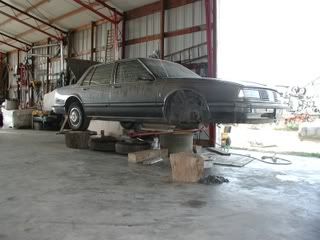
    I couldn't rotate the motor, so I had to drop the cradle out on this one:

    Leave a comment:


  • JoeMechanic
    replied
    If you have the pan off and a new pump is cheap enough I would put a new pump ,screen and pan gasket but thats me.If you don't have a problem at all with the car then leave it alone..if it isn't broke don't fix it..sound familiar?.

    Leave a comment:


  • 93 GP LE
    replied
    Thanks I will just leave the engine alone. I don't race the car so I guess the engine will be okay if I take care of it.

    Leave a comment:


  • geoffinbc
    replied
    Originally posted by 93 GP LE View Post
    Thanks I will just leave it alone. But If any one else has the 3.1L engine have you ever taken off the oil fill cap with the enigne running? Because when I did this on my car with the engine at operating temp their was no oil coming out the tops of my push rods at idle but it sprays out if I rev the engine to around 2,000 rpms. I use 10W30 moble one synthetic and AC delco filters.
    Thats completely normal. I use Red Line 5W30 Synthetic and Delco filters and it works beautifully for me.

    I just got back from a camping trip and on the highway I pulled an 8% grade for 17kms. I had the bed fully loaded with camping gear me, my girlfriend and the dog in the cab. I had it pegged wide open in 4th gear 3500 RPM doing about 120~130K up the entire hill. The oil did get rather hot because the pressure at idle was lower than normal but as things cooled off the pressure was back up. Needless to say I am impressed with the old iron dog.

    Leave a comment:


  • ollopa
    replied
    You could always buy an oil pressure gauge and see if your pressure is low.
    The rule of thumb is 10psi for every 1000rpm. On edit you could also try a thicker oil. What weight are you running now?
    Last edited by ollopa; 09-03-2007, 07:06 PM.

    Leave a comment:


  • 93 GP LE
    replied
    Thanks I will just leave it alone. But If any one else has the 3.1L engine have you ever taken off the oil fill cap with the enigne running? Because when I did this on my car with the engine at operating temp their was no oil coming out the tops of my push rods at idle but it sprays out if I rev the engine to around 2,000 rpms. I use 10W30 moble one synthetic and AC delco filters.
    Last edited by 93 GP LE; 09-03-2007, 06:55 PM. Reason: forgot somthing

    Leave a comment:


  • ollopa
    replied
    I doubt it's your screen. It's more likely to be a combination of wear on your main bearings and your oil pump. If you drop the pan, might as well change that pump. But I think "just leave it" is good advice.

    Leave a comment:

Working...