If this is your first visit, be sure to
check out the FAQ by clicking the
link above. You may have to register
before you can post: click the register link above to proceed. To start viewing messages,
proceed to the Forums area and select the forum that you want to visit.
...................
An a-2-w has a MUCH lower pressure drop, usually in the range of .1psi drop compared to the .35 pressure drop of an "a-2-a". They also can have as little as 1/4 the physical size of an equivilant A-2-A, and use MUCH shorter plumbing. This reduced volume (not reduced diameter or flow-rating) between the compressor and the throttlebody translates to faster pressurization and quicker boost response......
Length of tubes and volume of the intercooler system is important for good boost response in a turbo system, and I have found it to be critical in a supercharged system with an upstream TB. So much so that it can be rendered undrivable when a remote intercooler is used. I will probably start a thread on the intercooler install, as it will be more of a challenge than simply adding the blower was. That was almost too easy
My guess is plenum volume. Having an a2a behind the throttle would increase plenum volume much more then a2w. Since it needs to be plumbed behind the throttle blade and to a place where it can get good ambient air flow.
Turbo can intercool ahead of the throttle, making a2w less desirable as it is less efficient cause it is really air to water to air again.
Just a guess though...seems logical.
The factory uses them simply due to space constraints. They can be mounted in the intake and dont require extra plumbing. Its really for no other reason than that. Its actually a lot cheaper to a-2-a's, but modern day engine compartments are super tight now-a-days.
And actually, an air-to-water IC is much more optimal for a turbo system than using a A-2-A.
An a-2-w has a MUCH lower pressure drop, usually in the range of .1psi drop compared to the .35 pressure drop of an "a-2-a". They also can have as little as 1/4 the physical size of an equivilant A-2-A, and use MUCH shorter plumbing. This reduced volume (not reduced diameter or flow-rating) between the compressor and the throttlebody translates to faster pressurization and quicker boost response.
An A-2-W IC can potentially have greater cooling efficiency inch per inch since water transfers heat MUCH better that air does, but overall efficiency is ultimately dictated by the size of the heat exchanger and IC used in the application
Ive swapped over to a A-2-W myself to make space for my oil-tank in the front/pass bumper-cover. It flows a max of 700cfm a .1 psi drop. Since I'm making a hair under 600 hp, this is good enough for my build.
..........
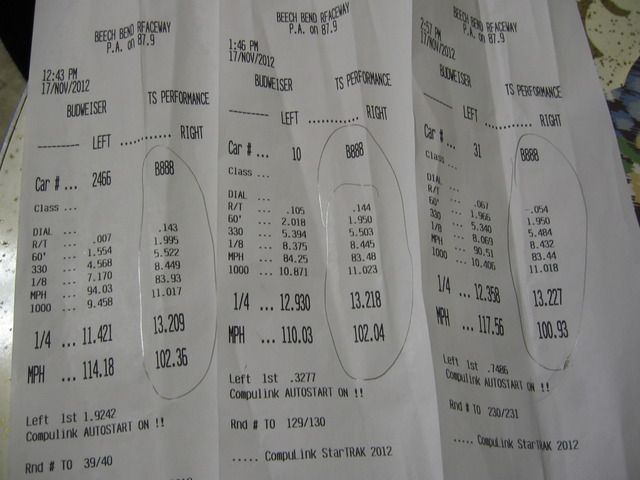
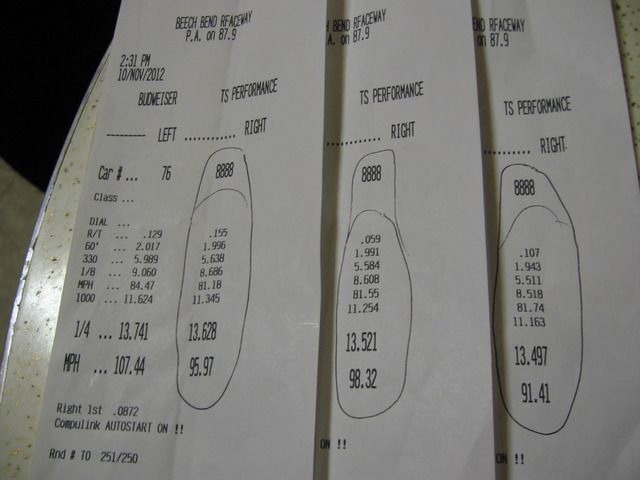
And got some runs in at Beech Bend Saturday afternoon. Nice 75-degree day, 7.5 inch slicks, bypassed filter. I forgot to have the tank full, it's been over a year away from the track, so it ran out of fuel near the end of track on each run.
Let's try that again....
(10-17-2012) Beech Bend Park
60-65 degrees F. (good air), Gas tank full, filter bypassed, stock MAF, TCE 68mm TB, 36 lb. injectors, Racetronix pump, stock FPR, 3-inch full exhaust, no resonator, 7.5 inch M&H slicks, custom trans, stock engine, air-cooled UIM.
Net Temp rise, Filter to UIM (after burnout, from start to end of run): approx.100 degrees
Net Temp rise recorded in UIM (from start to end of run): approx.50-60 degrees
Injector duty cycle 83% maximum, MAF 10.2K, 32 lb/min
Of course, I was just pointing out how air to water has two heat exchangers where air to air only has one generally. Your example is only one heat exchanger with water, so I guess it's a true water to air instead of air-water-air.
Now that I think of it, water can take more heat energy to cool versus the same mass of air. Making for greater heat absorption over time.
Three types, air-air, air-water-air, water-air....lol
not to drag it on but.....a2w are less efficient then a2a per cross section area. Because an a2w is actually two stage heat transfer. Air to water then back to air again. Makes it less efficient then regular air to air. That and the water can become heat soaked, where the a2a does not.
I am pretty sure water takes longer to heat up then air does, making a2w slower at cooling the air charge. That I'm not 100% on.
With the complex nature of plumbing a2w, the efficiency drop, heat soak issues......a2a is far better. Unless you plan to ice the cooler or cryo spray, even then a2a can do that too. The advantage is having far less volume needed to cool X amount versus a2a.
That's my take on it, not going to clutter up the thread.
No, for track (and very short-duration street lol) use, iced-water remote IC without a front heat exchanger is more efficient than air-to air. By the time you've "iced" an A2A and sized it big enough for low pressure drop, it's space advantage disappears.
And the A2A does get some heat-soak during the burnout, whereas the iced A2W generally will get colder.
not to drag it on but.....a2w are less efficient then a2a per cross section area. Because an a2w is actually two stage heat transfer. Air to water then back to air again. Makes it less efficient then regular air to air. That and the water can become heat soaked, where the a2a does not.
I am pretty sure water takes longer to heat up then air does, making a2w slower at cooling the air charge. That I'm not 100% on.
With the complex nature of plumbing a2w, the efficiency drop, heat soak issues......a2a is far better. Unless you plan to ice the cooler or cryo spray, even then a2a can do that too. The advantage is having far less volume needed to cool X amount versus a2a.
That's my take on it, not going to clutter up the thread.
Based on what I understand, SC's produce heat sooner and more of it than a TC. So for a drag car with a SC, it would be faster to cool and prevent majority of the heat soaking to occur. However, with all the types of liquid injections available, an A2W is really not needed anymore (meth/water/alky) .
I swear, Moses didn't put up with this much blasphemy! heh
No blasphemy, just trying to figure out why SC guys typically go A/W... that's all. And with a Roots type blower it makes sense because the positive pressure is post TB so plenum volume comes into play, where a centrifugal SC the boost is like a turbo setup.
I guess if somebody in the community really had to have a set of castings, I could probably do that, but the mounts are just in the prototype stage. They seem sturdy enough, but who can tell what could happen with severe road use. Now if one of the "Big Three" (ha), WOT-Tech, MMS, or BCC wanted to make and test mounts, that would be great, but they're not that interested in this platform, it would take their time and money. I don't have any way to make precision cuts or obtain good aluminum stock material, or even a welder. I can tell you it's nerve-wracking drilling holes in those castings lol. Also, the case mount system will most likely have to be modded for intercooling.
You'd have to get the SC from Magnuson Products, then make the mounts from patterns or pics. And also, a 4-inch notch has to be cut out of the hood bracing. Right now, unmounting of the SC requires removing the inlet casting, 9 bolts, and loosening 3 others. You have to do that to change spark plugs 2 and 4.
That being said, the effort is well worth it to me. The car made it a good 180 miles loaded down round trip to the track, got beat on, and ran effortlessly, worn-out engine and all.
I swear, Moses didn't put up with this much blasphemy! heh
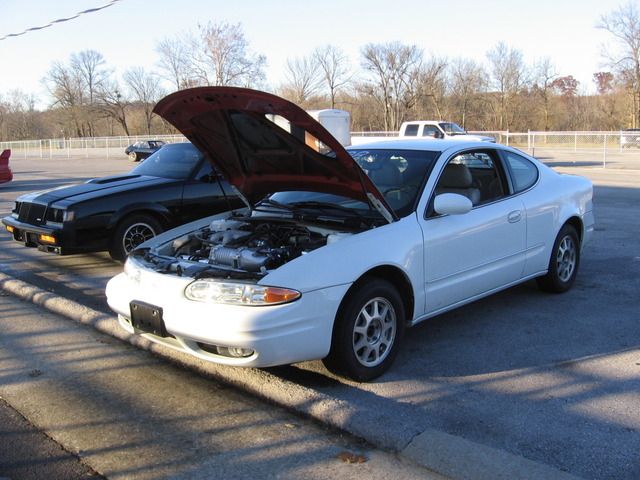
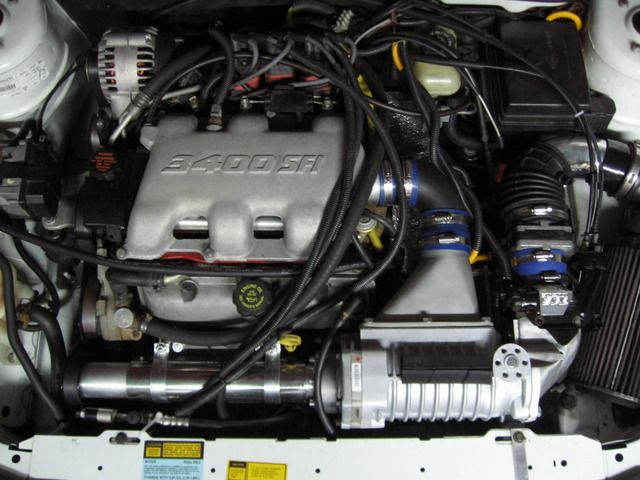
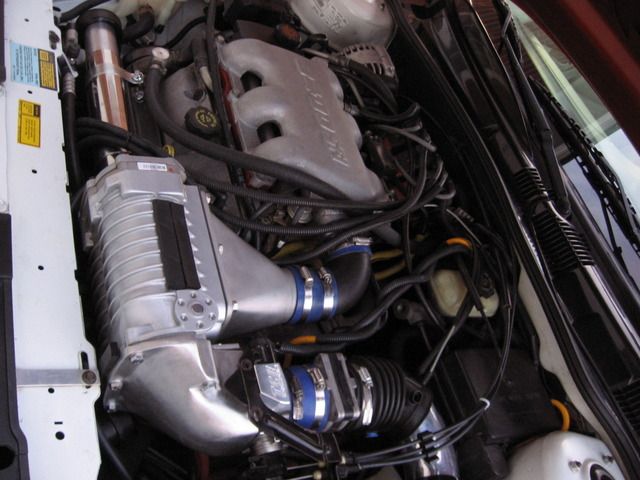
Anyway, moving on, constructed a new and improved driveshaft mount and installed my straight shot UIM with transition pipe:
And got some runs in at Beech Bend Saturday afternoon. Nice 75-degree day, 7.5 inch slicks, bypassed filter. I forgot to have the tank full, it's been over a year away from the track, so it ran out of fuel near the end of track on each run.




Leave a comment: