If this is your first visit, be sure to
check out the FAQ by clicking the
link above. You may have to register
before you can post: click the register link above to proceed. To start viewing messages,
proceed to the Forums area and select the forum that you want to visit.
200-225hp is high for the iron head N/A. I would like to see if it could be done, but after comparing the iron and aluminum heads I wasn't going to waste any more time on them. I'm expecting 250hp with a 3.4 and 3500 top end, cammed, ported/polished, polished chambers, valvetrain upgrades, headers, and MegaSquirt tuning.
Here are the differecnes between the iron and aluminum heads...
A private space for your group's photos and videos. Share, react, and relive moments together. Available on iOS, Android, and desktop. Free for new sign-ups.
You have a much better starting base with the aluminum heads.
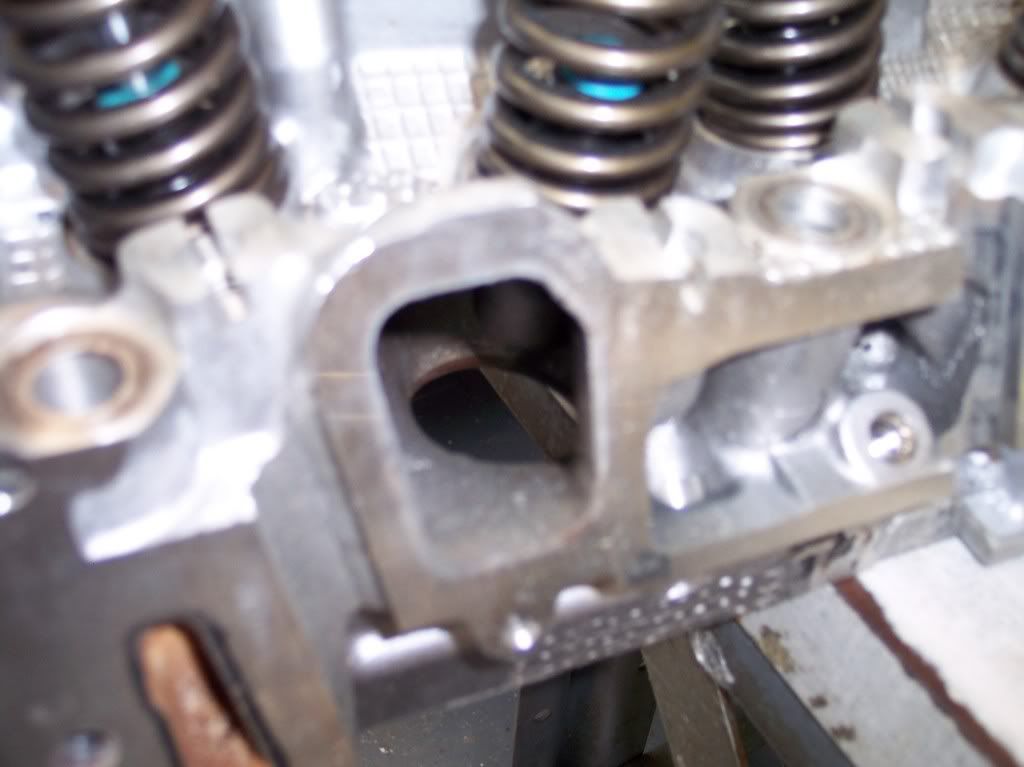
Two more pics of a 3500 port with the valve removed...
Your machinist is right that extreme ported heads need high rpm to really live to their full potential, but they will pretty good at lower rpm's as well they just won't live to their full potential.
This would also dictate why your max hp is so low in the rpm band. You really should be pulling to at least 5500 with your current setup 10.1 compression and good flowing heads and intake.
I would try and find someone that has a flow bench and get some numbers on them. This will give you some idea how well they should perform on your setup, or you can just slap them on and see how they actually perform. The most your out is gaskets and time.
I honestly believe that with good flowing heads and intake you should see close to 200-225+hp at around 5000-5500 rpm.
I know how frustrating this can be. I've been on both sides of the fence having built engines that performed better than they were expected to and those that just didn't, but better flowing heads weather mild or race porting have ALWAYS produced a substantial increase, weather or not they were more than the engine needed.
A recent example is one of our current cars is a 65 mustang that we built a 302 solid roller engine with stage three ported 351w heads that should not be pulling hard past 7500, but continues to pull extremely hard to 8000+ and high 6's in the 1/8 mile.(go figure)
I would also change the thermostat to 180 and adjust your fan to come on at 210 off at 195 with 180 thermostat.
Keep us posted on the out come.
Hope this helps.
"ezrollin, that wasnt meant to be rude. sorry bout that," I feel for you buddy,it's a bitch to spend that much money and get those kind of results. That tuner sounds like a real dick, I have equal respect for any guy that builds his ride whether it's a 4 cyl. or big block. I've done the V8 thing and now researching a turbo V6,good luck hope you find your problem!
You are correct about the engine temperature, however it's the blanket nature of the statement that can lead to error. You should run the highest temperature that you can without detonation. If you can get away with 200-220 that's what you should run, otherwise run lower temps. So I stand corrected.
The other stuff i'll debate amongst myself some of which was interpreted contrary to what to what I intended. I knew I had the urge to bring my physics book with me for some unknown reason. I left it home anyway.
As for horsepower TV, the demo was performed without fuel treatment for the octane effect, in which case if the LS series engine runs better on premium than mid grade then we can agree premium is not less efficient in this setting which was the point I was trying to make all along; that the differences between the subject being addressed and the model it is being compared to can not be ignored when assessing benefits that require other parameters be met.
I do turbos so I'm biased towards cooler temps from the "git go".
Hope you don't mind this entry merlot but I think it's important to admit when we are mistaken and I was.
im with you sharkey! i used to look up to chris and wanted a z24 like his when i had my z24 years back. but ive forgotten about his set up. after taking a look again at his old site, i reralized a few things. turbo is the way to go with these heads. and i was worried about valve clearance, he had something north of .600'' of lift and tons of duration on that cam he had!
i know the 3500 will be my best option, but i dont have one right now, and im sick of working on the fiero for now. ill turbo it and leave it be.
ironheads unported dont flow, and the intake becomes a big restriction. the truleo helps a bit, but its still not designed very well.
if it was mine (and i have something simular) id port the hell out of the heads and boost the thing. the most powerfull 660 here to date was curtis walkers 3.1l ironhead, making 471whp.
ok so weve beat the hell outa coolant temps, octane and nascar engines.... what about helping me find out what caused the lack of hp and how to get it to where it should be. btw im thinking of going turbo, using the gt3582r trbo, this is how ive figured using this turbo http://www.squirrelpf.com/turbocalc/...40&map_sel0=42
ok so weve beat the hell outa coolant temps, octane and nascar engines.... what about helping me find out what caused the lack of hp and how to get it to where it should be. btw im thinking of going turbo, using the gt3582r trbo, this is how ive figured using this turbo http://www.squirrelpf.com/turbocalc/...40&map_sel0=42
I see your point however the examples you gave are not good comparisons, special coatings, and knife edging a crank are more like constants, their properties don't change relative to the surroundings, a slippery surface remains slippery and the aerodynamic slicing qualities of a crank are not affected by the engine application. Heat = energy is not the complete equation otherwise it would suggest the hotter the engine the more power it produced. In this case heat is a by product of combustion a portion of which is wasted energy a large part of which can be recaptured by a turbo for example. Running the engine leaner will produce more heat but it will not necessarily increase power output.
How are they not good comparisons? They were developed from racing then applied to street use. Just because the application can be carried over fairly easily does not mean it's any less relevant. Are you trying to say that engine theory between the two can't be shared?
When I was explaining heat = energy that was based on the energy produced by the fuel source. It had nothing to do with engine temperature, since that is a byproduct of fuel burning. Instead it simply means the more energy/heat a fuel source can provide the more power it can create. That's why many people don't really like E85 as an alternative fuel source. Not only is it more expensive, but it will drop mileage due to lower power output.
You did mention the air gap intake manifold and its benefits which I also stated has an effect along with other mods our engines don't have to insure the same results at higher temps. Being familiar with physics you know the rate of heat dissipation is directly affected by the metal transfering it, in which case an aluminum block vs. an iron block will register different temps at the same water temp. Over port iron heads and your engine will run hotter. Another issue is the fuel, NASCAR engines need more compression to burn their high octane fuel properly and visa-versa, the temp they run is a function of the fuel they are required to run as was stated, for a more efficient burn. Who knows what else they did to get more power at those temps permitted by the fuel composition; leaner mixture, more timing, you just don't know.
No NASCAR engines use high octane due to there high cylinder pressures. Not vice-versa. I already explained this. Now if your wondering why the fuel requirement is in the rulebook then that's simple. If left unchecked then teams would find ways to get even higher octane gas so that timing could be increased a little more for a slight HP improvement. In a sport where HP is everything, they will research and implement anything that will get a HP increase.
Premium fuel being less efficient is an incorrect statement, it's less efficient in engines that do not have the necessary compression to burn it efficiently. Otherwise we can save more money and make more power on cheaper lower octane fuel like 80 octane vs. 87 and 7:1 compression for example.
Premium is less efficient. When you require more energy to make it burn vs low octane gas then there is a net loss of energy. Thus it is less efficient. People only see a gain with premium because it's harder to cause detonation with it. That allows for an increase in timing. Lower octane would work better but it can't operate with high cylinder pressures caused by high compression, large cam, large pistons, advanced timing or some form of boost.
If you can go back and catch last week or the week before lasts horsepower TV, you can see the Dyno difference they demonstrated on television with a late model LS series chevy engine. They did a run with 87 octane and a run with premium octane fuel. Premium in the same engine made more power and better fuel economy according the computer generated results, which measured the fuel consumption as part of the dyno pull because a vendor provided a fuel treatment product that goes in the fuel line and treats the fuel resulting in higher mileage. They did that run last and it proved that the product actually did what the vendor said it would.
Your believing something off of Horsepower TV? A sponsor driven show that will do anything to make it's sponsors look good. Not to mention testing an octane additive? Come on.
But if this test was done with an LS1 then yeah, low octane would of made it run worse. The LS1 was made with premium in mind so of course it will show an improvement. It would make more sense to use a 3400 and run the same tests again. I bet you won't see any improvement unless the engine was a KR monster.
Operating temperature versus the power output is simple. The lower your operating temperature the more heat (power) you are putting into the cooling system and then back into the atmosphere. The less energy you put into the coolant the more power goes to the wheels. It has been proven time and time again and dynos and racers have proven it. You wont find one winning race team running a 180 stat. No matter what the class. If you pick up Smokey Yunicks power secrets you will read about this. If you read Engine Masters you will see it too.
Racers and Enthusiasts know that a 200 to 210 coolant temp and 200 to 230 oil temperature makes the most power and best fuel economy in pretty much any racing or driving condition.
Also if you are a person who is looking for every last drop of power running a higher operating temperature (but still staying safe) will allow you to not only put less heat into the coolant but also run a smaller pulley on the waterpump. On a SBC you can underdrive the pump as much as 75%. A theory I am going to explore on my 660. I have a friend who owns a plastic mold making shop and I am going to have him make me about 4 different water pump pullies of different diameters to try and drive it as slow as I can. I may even do the same with the power steering pump.
I'm wondering myself if the 180F stat I put in is killing my power. I drilled 2 holes in it and I didn't even have to bleed the system. (no air came out). It bled itself! Normally you have to wait until the stat opens which takes a long time of idling with the hood down.
Anyway, the temp gauge is under 1/4 now (normally right at 1/4). And the motor just seems to not have the power when stock. It does run worse and rough when it gets hot before the fan kicks on, but this is sitting in traffic and taking off which isn't much of an issue when you are moving.
I think I will throw the 195F back in there and see where I'm at.
Should I drill holes? If so, how many? Will one be enough to burp itself or do I need to put one on the bottom too to prevent vacuum?
I mentioned that the engine has to be tuned for the lower temps, GM used engine temp to determine when closed loop starts and other important functions so if you never reach the proper engine temp your fuel mileage will suffer and eventually power.
I drilled holes in my stat base as a safety against overheating in the event it goes bad and also to help keep the engine cooler without taking the stat out. Something I read about in chevy highe performance years ago, it also helps bleed the system. I think CHP recommended about an two 1/8" holes not sure. I did more though, I think four, but my engine is turbocharged and I have to error on the safe side.
I'm wondering myself if the 180F stat I put in is killing my power. I drilled 2 holes in it and I didn't even have to bleed the system. (no air came out). It bled itself! Normally you have to wait until the stat opens which takes a long time of idling with the hood down.
Anyway, the temp gauge is under 1/4 now (normally right at 1/4). And the motor just seems to not have the power when stock. It does run worse and rough when it gets hot before the fan kicks on, but this is sitting in traffic and taking off which isn't much of an issue when you are moving.
I think I will throw the 195F back in there and see where I'm at.
Should I drill holes? If so, how many? Will one be enough to burp itself or do I need to put one on the bottom too to prevent vacuum?
1 hole 3/16" is all I have ever done on SBC's, along with a few other cars in stock form.
You would be surprised how much stuff from racing is carried over to street vehicles. Examples: knife edging and undercutting counterweights (see 3500 crank), small or no grill openings for radiator (name your late model J body), coatings for engine components (see revised 3400 pistons) and thats just stuff of the top of my head.
As for differences, well they can't really be all that different. Both are V shaped, pushrod, gas powered, internal combustion piston engines. What improves efficiency for one will do the same for the other. If you were talking about a diesel, rotary or turbine vs. a gas powered IC engine, then you may have a point.
High octane gas is also less efficient then regular 87 octane gas. NASCAR engines use such a high octane because of the high combustion chamber pressures they generate (compression is only a part of it). It is actually a draw back that they have to use high octane because low octane generates more heat while having a lower flash point. Now if you remember your physics class you'll remember that heat = energy. Thus the more heat you generate the more energy is available.
You felt a difference with the higher engine temp because of the increase in intake air temperature. Old V8 engines suffer from the same problem 60*V6 engines have, to much metal surrounding the intake runners. Why do you think edelbrock came out with there "Air Gap" series for those old V8 engines? It's the same thing NASCAR engines moved to, from using traditional intake manifolds. It makes a difference because the intake is not acting so much as a heat sink due to less metal and more air flow around the intake runners. That's what engine builders always strive for: a cold intake with hot heads and block. It creates the most efficiency thus providing more power with less waste.
I see your point however the examples you gave are not good comparisons, special coatings, and knife edging a crank are more like constants, their properties don't change relative to the surroundings, a slippery surface remains slippery and the aerodynamic slicing qualities of a crank are not affected by the engine application. Heat = energy is not the complete equation otherwise it would suggest the hotter the engine the more power it produced. In this case heat is a by product of combustion a portion of which is wasted energy a large part of which can be recaptured by a turbo for example. Running the engine leaner will produce more heat but it will not necessarily increase power output.
You did mention the air gap intake manifold and its benefits which I also stated has an effect along with other mods our engines don't have to insure the same results at higher temps. Being familiar with physics you know the rate of heat dissipation is directly affected by the metal transfering it, in which case an aluminum block vs. an iron block will register different temps at the same water temp. Over port iron heads and your engine will run hotter. Another issue is the fuel, NASCAR engines need more compression to burn their high octane fuel properly and visa-versa, the temp they run is a function of the fuel they are required to run as was stated, for a more efficient burn. Who knows what else they did to get more power at those temps permitted by the fuel composition; leaner mixture, more timing, you just don't know.
Premium fuel being less efficient is an incorrect statement, it's less efficient in engines that do not have the necessary compression to burn it efficiently. Otherwise we can save more money and make more power on cheaper lower octane fuel like 80 octane vs. 87 and 7:1 compression for example.
If you can go back and catch last week or the week before lasts horsepower TV, you can see the Dyno difference they demonstrated on television with a late model LS series chevy engine. They did a run with 87 octane and a run with premium octane fuel. Premium in the same engine made more power and better fuel economy according the computer generated results, which measured the fuel consumption as part of the dyno pull because a vendor provided a fuel treatment product that goes in the fuel line and treats the fuel resulting in higher mileage. They did that run last and it proved that the product actually did what the vendor said it would.





Leave a comment: